The global demand for ready-to-eat bakery and snack products requires manufacturers to continuously evaluate and upgrade their facility capacities. For businesses relying on semi-automatic or outdated equipment, fulfilling large-scale orders often leads to operational bottlenecks, inconsistent product weights, and excessive labor costs. Scaling up operations to meet commercial retail demands necessitates systems that eliminate these variables. The B&F Engineering Pancake and Sandwich Pancake Production Line provides a structured, high-volume automation solution designed to stabilize the manufacturing process, increase hourly output, and maintain strict structural uniformity across every batch. This article examines the strategic shift to full automation and the operational mechanics of industrial pancake processing.
Resolving Bottlenecks in Pancake Manufacturing
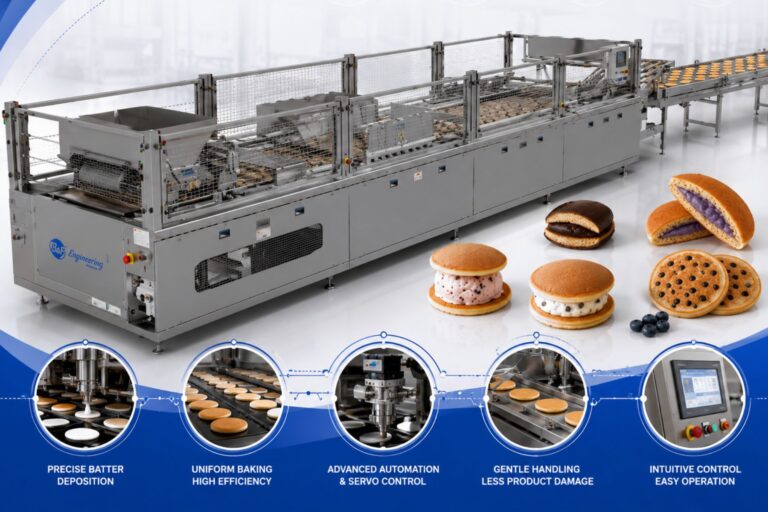
In medium-to-large scale food facilities, production bottlenecks typically occur at the batter dosing and sandwiching stages. Manual or semi-automatic dosing leads to weight variations, resulting in uneven baking times and higher rejection rates during quality control. Furthermore, applying fillings (such as chocolate or cream) and aligning two pancakes for sandwich products manually slows down the entire line. By integrating a fully automated Pancake Production Line, these specific pain points are eliminated. Programmable Logic Controllers (PLC) manage the exact volume of batter deposited, synchronize the baking tunnel speed, and perfectly align the sandwiching mechanisms. This synchronization ensures that the line operates at its maximum engineered capacity without the delays associated with manual intervention.
How the Production Line Works
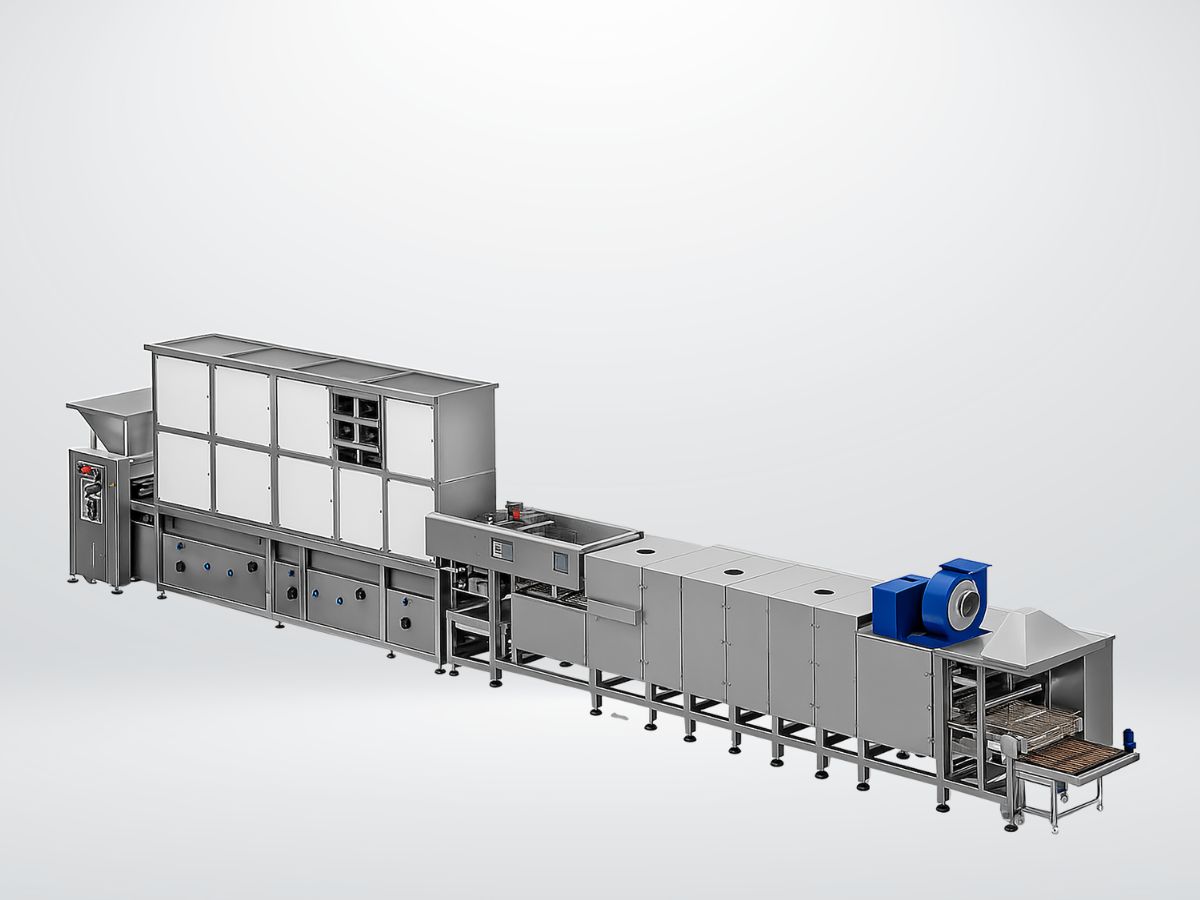
An industrial production line operates through a sequence of synchronized mechanical and thermal stages. The standard operational flow includes:
- Automated Batter Dosing: Homogenized batter is pumped into the dosing station. Precision nozzles deposit exact volumetric portions of the batter onto the pre-heated, continuously moving baking belt or plates.
- Primary Surface Baking: The batter enters the heated tunnel oven. The temperature is strictly regulated to bake the bottom surface, developing the required structural integrity and color.
- Mechanical Flipping: Once the bottom is baked, mechanical arms or automated vacuum lifters flip the pancakes seamlessly to expose the uncooked side to the baking surface.
- Secondary Surface Baking: The flipped products continue through the oven, ensuring the core is fully cooked and the top surface matches the bottom in color and texture.
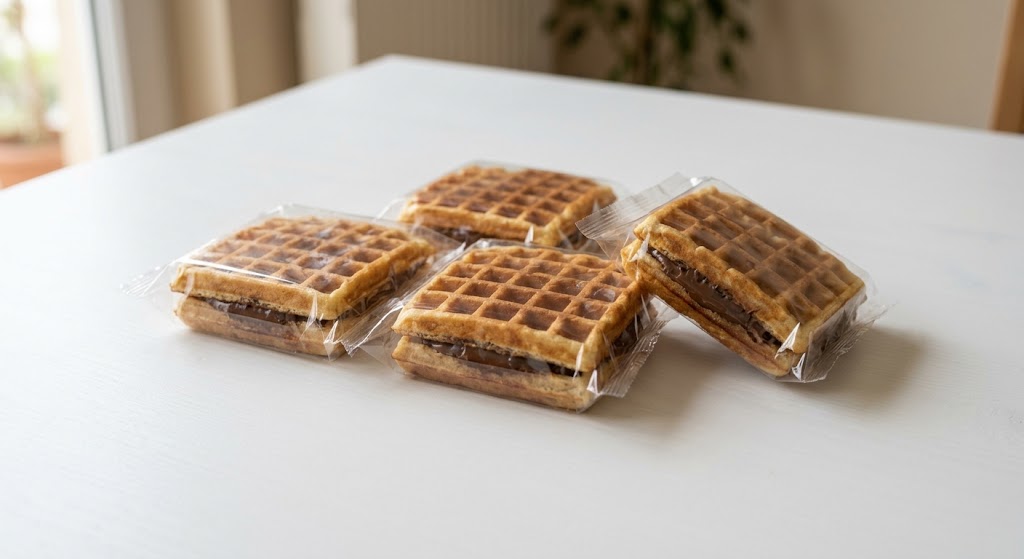
- Filling Injection and Sandwiching: For sandwich pancake production, the line diverts half of the baked pancakes. Precision nozzles inject a calibrated amount of filling (cream, jam, or chocolate) onto the center. The remaining plain pancakes are mechanically lifted and placed accurately on top of the filled halves.
- Cooling and Discharge: The finished single or sandwich pancakes are transferred to a wire mesh cooling conveyor to reduce the internal temperature, preventing condensation inside the packaging.
Advantages in Industrial Production
Implementing a specialized Waffle and Sandwich Waffle Production Line offers distinct operational and financial benefits for large-scale manufacturers:
- Waste Minimization: Highly accurate servo-driven filling nozzles prevent product leakage, drastically reducing raw material waste and machinery downtime caused by cleaning spills.
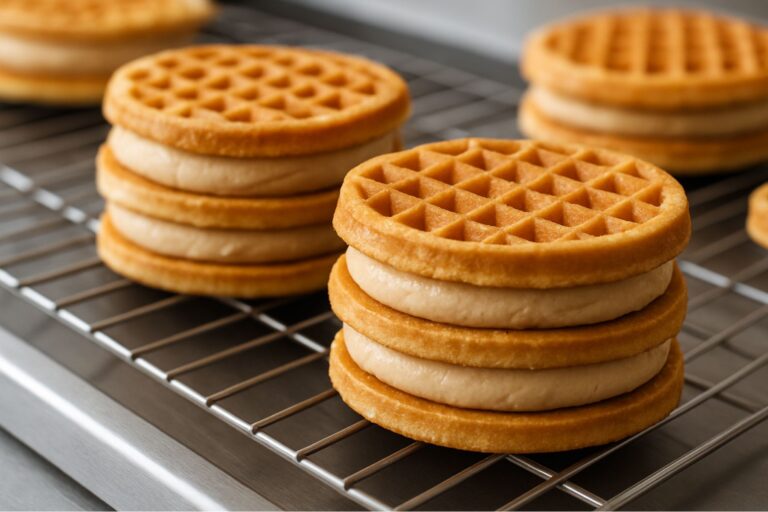
- Product Standardization: Automated alignment ensures every sandwich waffle looks identical, maintaining a premium brand image and fitting perfectly into standard automated packaging.
- Production Capacity: The synchronized, continuous motion of the line allows for the production of thousands of sandwich waffles per hour, easily meeting heavy retail demands.
- Labor Efficiency: By fully automating the complex filling and sandwiching stages, the facility eliminates the need for manual assembly lines, reducing labor costs and human error.
- Versatility: The PLC system allows operators to easily switch parameters to accommodate different filling viscosities (e.g., switching from thick caramel to lighter fruit jams) without halting production.
- Quality Control: Integrated sensors constantly monitor product weight, temperature, and alignment, automatically rejecting products that do not meet the set parameters.
What to Consider When Choosing a Production Line
Investing in commercial waffle machinery requires careful evaluation of technical specifications to ensure long-term profitability. Consider the following:
- Injection Precision: Ensure the dosing units for both batter and filling are servo-driven, as this provides the micro-millimeter accuracy required for deep-grid waffles.
- Mold Quality and Design: The baking molds must be made of high-quality, heat-retaining alloys with durable non-stick properties to ensure flawless de-molding.
- Sensor Technology: The line should be equipped with advanced optical or laser sensors to guarantee the perfect alignment of the top and bottom waffles during the sandwiching phase.
- Automation Interface (HMI): A user-friendly, digital touchscreen interface is crucial for quick recipe changes and monitoring real-time production analytics.
- Footprint and Modularity: Assess whether the line’s dimensions fit your facility and if it allows for future expansions, such as adding a chocolate enrobing section.
Maintenance, Cleaning, and Hygiene
In an environment where sticky batters and rich fillings are processed at high speeds, hygienic machine design is non-negotiable. The production line adheres to strict sanitary standards:
- Cleanability: The filling injection nozzles are designed with a “Clean-in-Place” (CIP) compatible structure, allowing for rapid flushing of the system between recipe changes.
- Hygiene: All product-contact surfaces, including conveyors and dosing units, are constructed from food-grade stainless steel, preventing microbial contamination.
- Maintenance: Quick-release mechanisms on the conveyor belts and open-frame architectures allow maintenance teams to perform daily sanitation routines efficiently.
- Food Safety: The system is engineered without hidden crevices or dead zones where food particles can accumulate, ensuring total compliance with global food safety regulations.
Waffle & Sandwich Waffle Production Line
Boost your productivity and product innovation with B&F Engineering’s advanced waffle and sandwich waffle production line. Our integrated systems combine speed, flexibility and hygiene to deliver consistent, high-quality waffles—tailored to meet today’s market demands.
Contact Us Today
Discuss your project with our engineering team and discover how our machines can optimize your production.