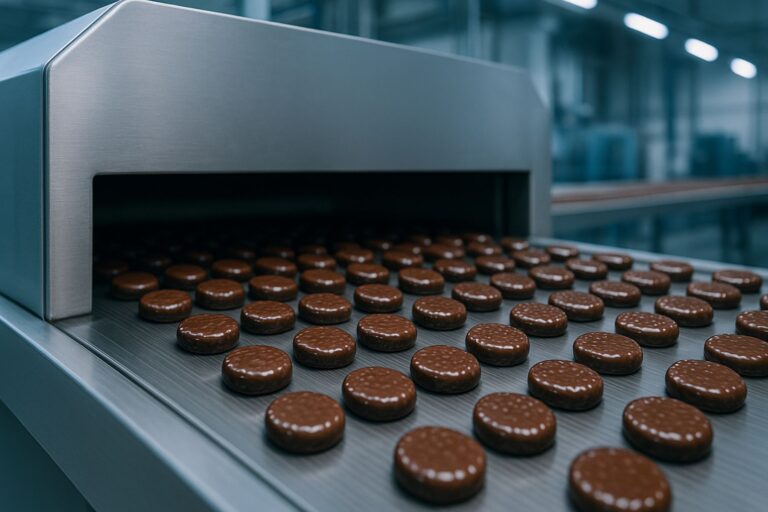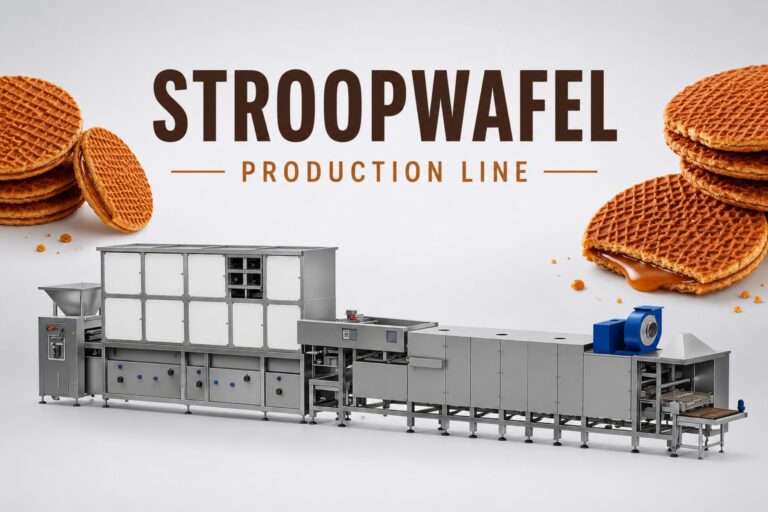
An industrial waffle production line is a continuous baking system that mass-produces Liege, Brussels, or soft American waffles while holding tight control over heat transfer and mechanical timing. To achieve consistent quality at high volume, a modern line must solve two engineering problems at once: maintaining absolute temperature homogeneity across moving baking molds, and releasing each finished waffle at high speed without tearing its structure.
This technical guide breaks down the advances in thermal distribution, servo-driven deposition, and PLC automation that define efficient commercial waffle manufacturing today — and the benchmarks that separate an intermediate line from a high-output turnkey plant.
1. Thermodynamic Optimization: Griddle Matrix and Heat Distribution
The quality of an industrial waffle — its crispiness, color uniformity, and internal moisture retention — is a direct function of heat transfer. Because a waffle line operates as a continuous chain of heavy baking molds (tongs), the system must compensate for rapid thermal dissipation during high-speed batter deposition.
Zonal Thermal Profiling
To prevent uneven baking or structural collapse, the baking tunnel is engineered with multi-zone temperature controls:
- Zone 1 – Flash Heating (Batter Injection): High thermal density is injected into the closed molds to instantly vaporize surface moisture, forming the initial crispy crust and driving internal leavening.
- Zone 2 – Core Cooking (Heat Penetration): Temperature is stabilized so heat reaches the core, cooking the starch matrix thoroughly without burning the sugars (caramelization control).
- Zone 3 – Final Crisp and Release Preparation: Temperatures are fine-tuned to optimize skin thickness and ensure clean release dynamics.
Air–Gas Pre-Mix Burner Engineering
For gas-heated lines, modern systems use automated air–gas pre-mix burners controlled by proportional valves. This architecture lets the flame profile adjust dynamically to line-speed changes, reducing gas consumption (OPEX) by up to 22% compared with atmospheric burners. Electric configurations instead deploy high-end ceramic infrared heating elements embedded within insulated hoods to maximize radiant energy transfer.
2. Advanced Depositing Controls for High-Viscosity and Pearl-Sugar Batters
Waffle batters vary drastically in rheology. Standard soft-waffle batter behaves as a fluid, whereas authentic Liege waffle dough is dense, sticky, and embedded with coarse pearl sugar. A capable commercial waffle machine must handle both without jamming or shearing the product:
[Dense Dough Hopper] → [Auger Feeding System] → [Servo-Actuated Volumetric Pocket Cutter] → [Direct Injection into Baking Molds]
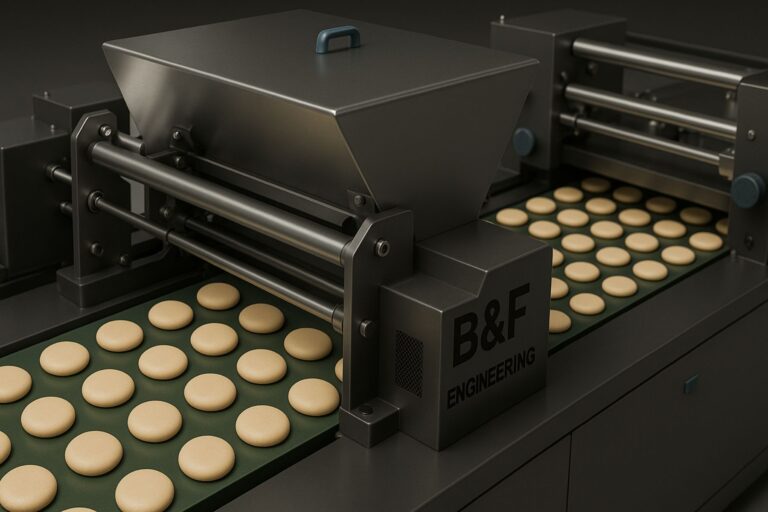
- Servo-Driven Volumetric Cutters: For dense doughs, multi-axis servo motors drive synchronized augers and cutting blades. The servo system monitors torque continuously; if a sugar pearl creates resistance, the PLC instantly recalibrates cutting force to hold a weight tolerance of ±0.5%.
- Non-Contact Nozzle Arrays: For fluid batters, pneumatic or servo-piston depositors use diving nozzles with suck-back seals. This eliminates batter dripping onto the baking-tong seals, preventing carbonization and shortening cleaning cycles.
3. Kinematic Synchronization and Smart Product Extraction
At production speeds reaching up to 40,000 waffles per hour, the continuous opening, flipping, and closing of baking tongs demands absolute kinematic precision.
- Precision Driving Chains: Baking tongs are mounted on heavy-duty, pre-stretched chains driven by central planetary gearboxes paired with Variable Frequency Drives (VFD). This setup eliminates mechanical backlash and chain vibration, which otherwise cause misaligned deposition or premature mold opening.
- Synchronized Vacuum Extraction Manifolds: Traditional mechanical needles often scar or tear the delicate hot waffle. High-speed lines instead use a multi-row rotary vacuum take-off system: the extraction drum rotates in perfect synchronization with the linear speed of the open baking tongs, gently lifting each waffle with food-grade silicone suction cups and transferring it to the cooling conveyor.
4. Automation and Maintenance: PLC and SCADA Integration
A premium turnkey waffle baking line operates as a connected smart machine. The automation backbone is typically anchored on high-performance PLCs such as the Siemens S7-1500 or Rockwell ControlLogix.
Centralized Recipe Management
An operator can switch the entire line configuration — from soft waffles to thin stroopwafels — from a 15-inch industrial HMI touchscreen. The PLC automatically adjusts:
- Baking-tunnel temperature profiles (±0.5 °C precision)
- Depositor volume and stroke timing
- Conveyor speed and fan-cooling curves
Predictive Maintenance with IoT Sensors
Embedded thermal sensors, vibration monitors on primary bearings, and current sensors on servo drives feed continuous telemetry to a centralized SCADA system. If a heating element loses performance or a chain tensioner drifts out of tolerance, the system raises a warning before an unscheduled line stoppage occurs.
Technical Performance Benchmarks
| Engineering Parameter | Intermediate Commercial Line | High-Output Turnkey Plant |
|---|---|---|
| Throughput Capacity | 10,000 – 15,000 pcs/hour | 25,000 – 45,000+ pcs/hour |
| Baking Tong Metallurgy | High-grade cast iron / alloy steel | Food-grade non-stick coated alloys |
| Heating Architecture | Direct gas / electric infrared | Proportional pre-mix gas / zonal electric |
| Control Interface | Standard touch HMI + PLC | Full SCADA + cloud remote diagnostics |
| Sanitary Compliance | CE / HACCP | Complete EHEDG / FDA sanitary standards |
Frequently Asked Questions
Optimize Your Bakery Automation Architecture
Whether you are scaling up production, replacing aging high-energy ovens, or integrating a fully automated downstream packaging line, a custom-tailored layout is essential. BAF Engineering designs and manufactures high-end, custom-engineered bakery production lines built for longevity and extreme thermal efficiency.
Contact our mechanical engineering department to request detailed line layouts, blueprint schematics, and a production-capacity assessment for your project.
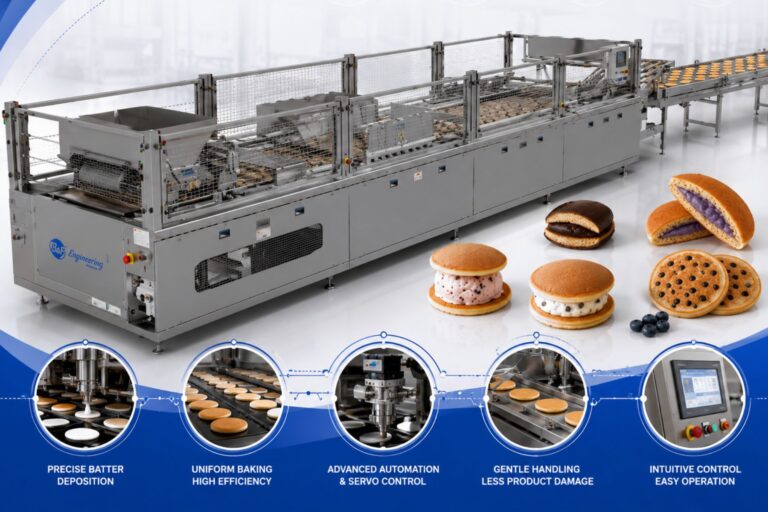
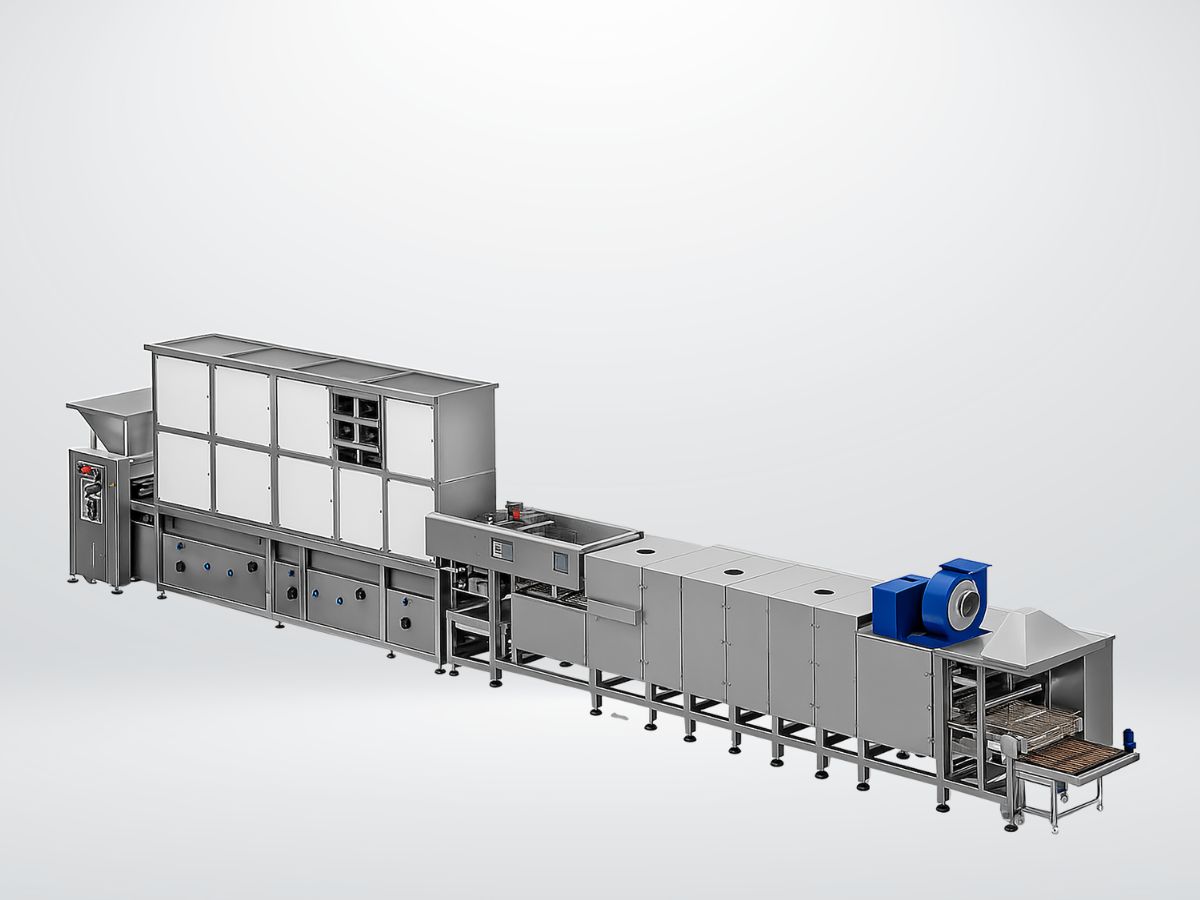
Waffle & Sandwich Waffle Production Line
Boost your productivity and product innovation with B&F Engineering’s advanced waffle and sandwich waffle production line. Our integrated systems combine speed, flexibility and hygiene to deliver consistent, high-quality waffles—tailored to meet today’s market demands.
Contact Us Today
Discuss your project with our engineering team and discover how our machines can optimize your production.