Dorayaki Production Line: How Industrial Japanese Pancakes Are Made
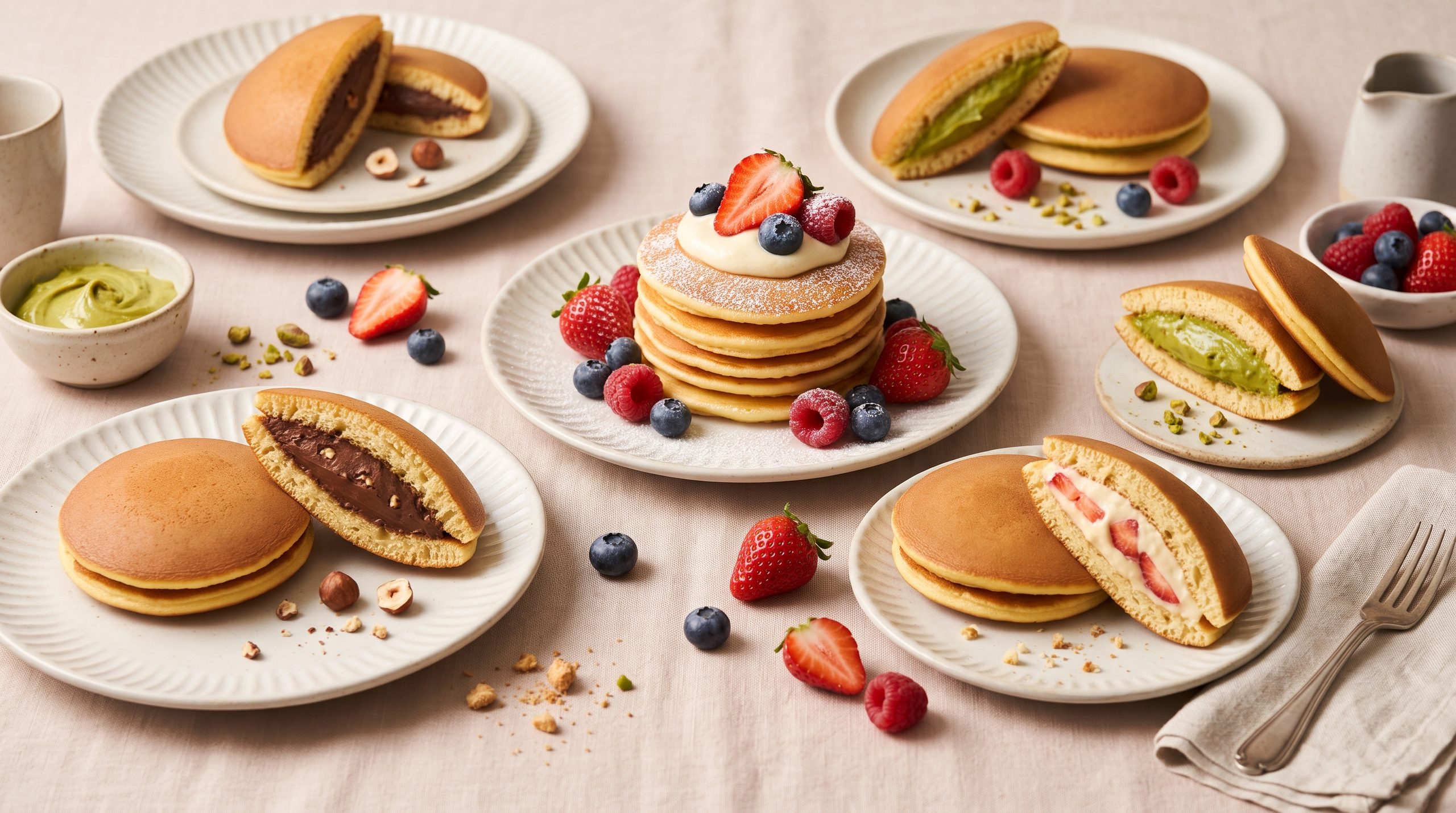
Dorayaki started as a Japanese confection: two soft, round pancakes sandwiched around a sweet filling, traditionally red bean paste. Today it is a global snack. Retailers in Europe, the Middle East and Asia sell dorayaki with chocolate, hazelnut cream, custard, jam and many other fillings, and factories need a dorayaki production line that can make them consistently, quickly and hygienically.
This guide follows the product from batter to packaging. It explains how each stage works, what affects quality and output, and what to ask a machine manufacturer before you invest.
What is dorayaki, in production terms?
For a factory, dorayaki is a sandwich pancake. Two pancakes are baked, one is filled, and the second is placed on top and pressed or sealed. The product is soft, moist and usually sold at ambient temperature in a sealed pack, which creates the real engineering challenge: keeping the pancake tender while controlling moisture and shelf life.
The same line also makes plain pancakes, sealed sandwich pancakes and other filled formats. That flexibility is useful, because many dorayaki producers expand into mini pancakes, stuffed pancakes or branded shapes later.
Stage 1: Batter preparation
Everything starts with the batter. Eggs, flour, sugar, leavening, oil, milk or water and flavorings must be mixed in a repeatable way. Small differences in viscosity or air content change how the batter flows, how the pancake rises and how it browns.
Industrial plants use closed mixing systems with tight control of speed, time and temperature. Planetary mixers with two agitators are common for dense or high-viscosity mixes, and scrapers keep the bowl clean so batches stay consistent. If you are choosing mixing equipment, see our Planet Mixers and read our comparison of planetary and continuous batter mixers.
Good batter management also means holding time. Batter that waits too long changes. Plan how much batter you make and when it reaches the depositor.
Stage 2: Depositing and baking
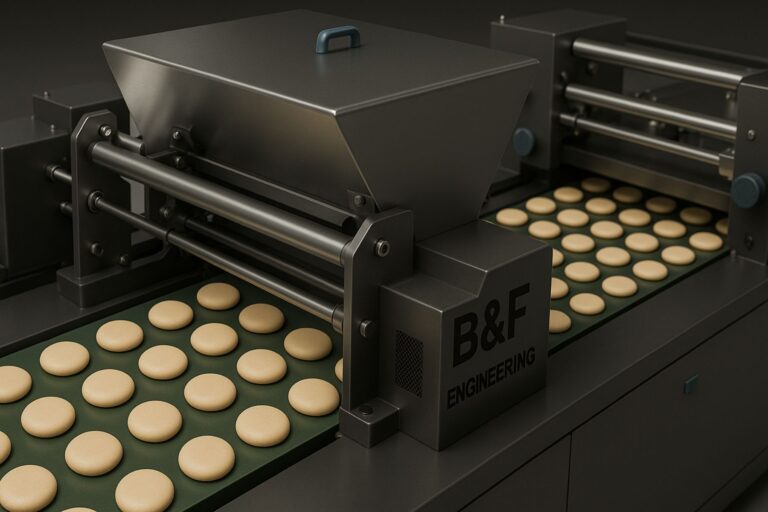
The batter is deposited into heated baking plates in exact amounts. Weight accuracy at this stage controls pancake size, thickness and, later, how well two halves match when sealed.
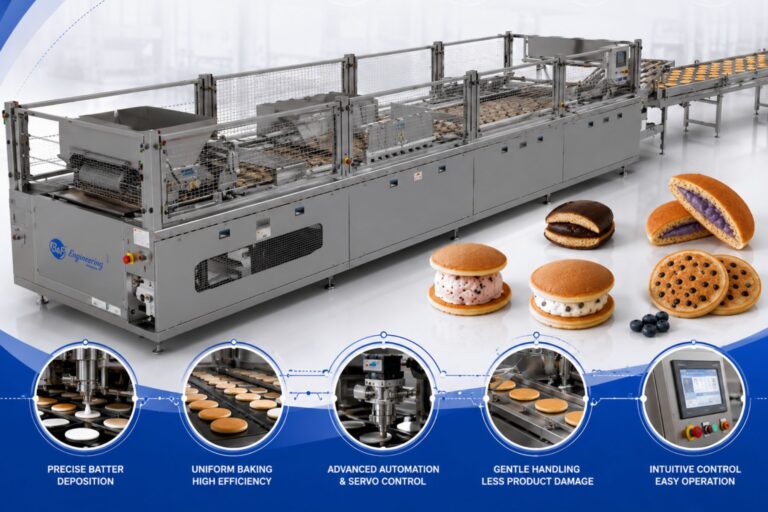
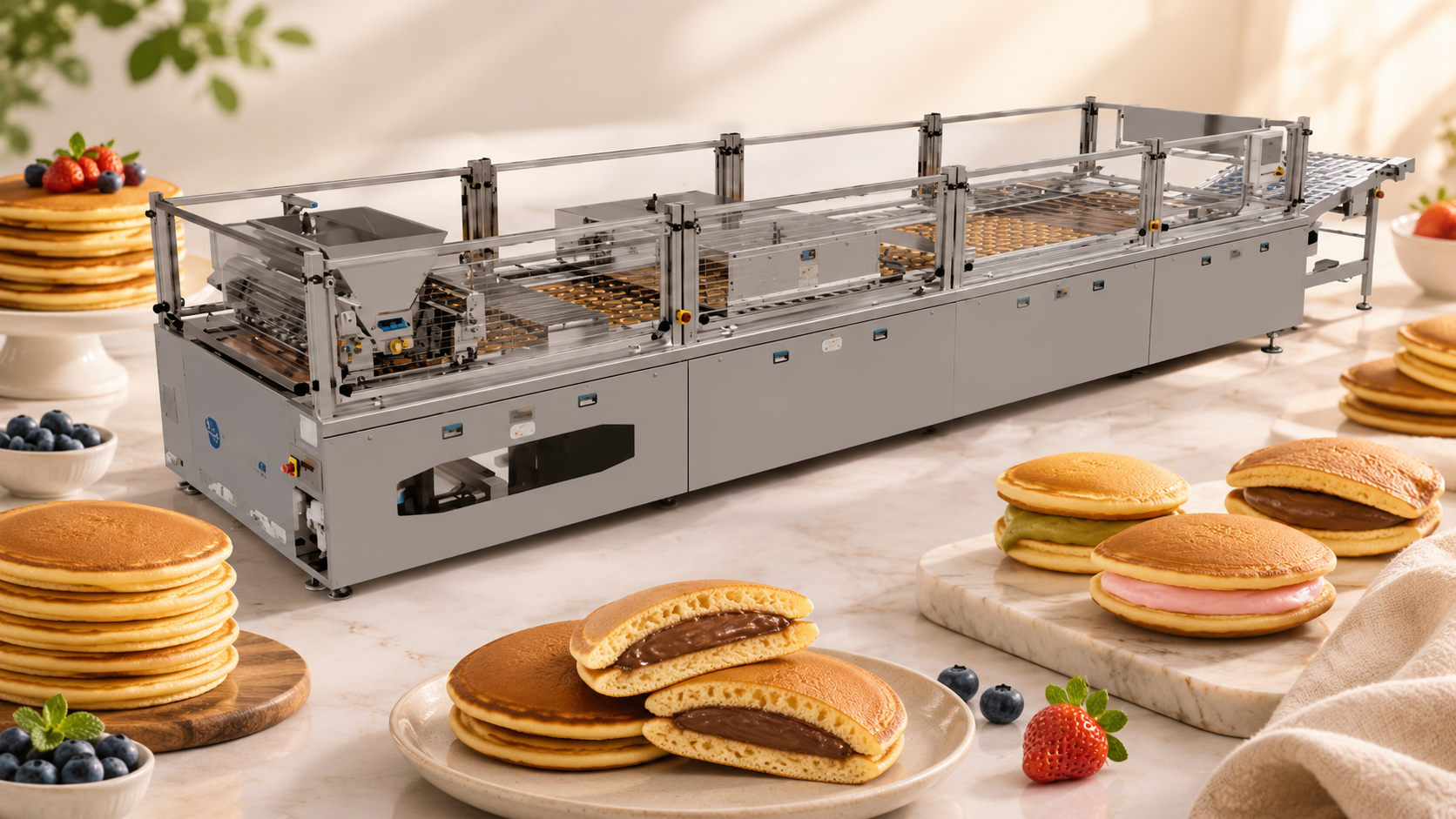
On B&F pancake lines the oven has high-efficiency baking plates, an adjustable griddle speed and top-mounted heating, so you can tune the result to the batter and recipe. Baking time is typically 100 to 120 seconds, which sets the relationship between oven length, line speed and output.
Surface color and softness depend on three things working together: plate temperature, dwell time and batter composition. If your pancakes brown unevenly, look at all three before you blame the oven.
Stage 3: Turning, cooling and alignment
After baking, pancakes are aligned and prepared for filling. The sandwiching unit on a B&F line is synchronized with the oven. It aligns, flips, fills and seals the pancakes gently, so the soft surface does not tear. Short, controlled cooling before filling prevents the filling from melting or the pancake from steaming in the pack.
Stage 4: Filling
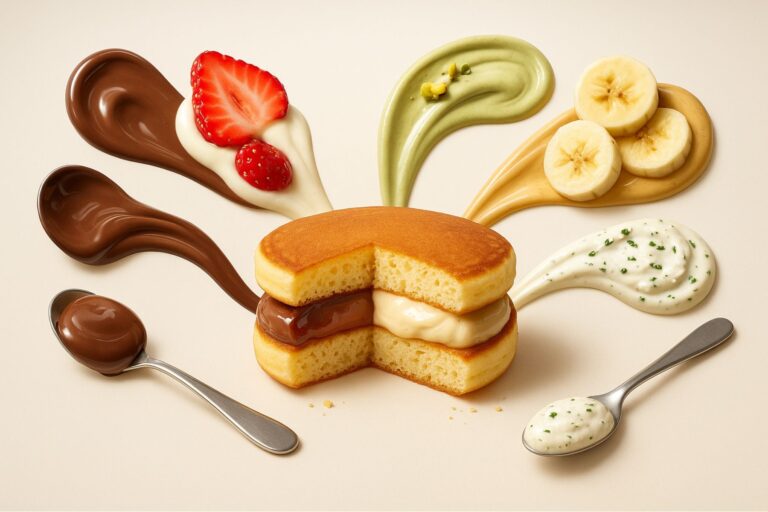
The filling is deposited onto one pancake, and the other is placed on top. Dorayaki fillings include:
- red bean paste (anko)
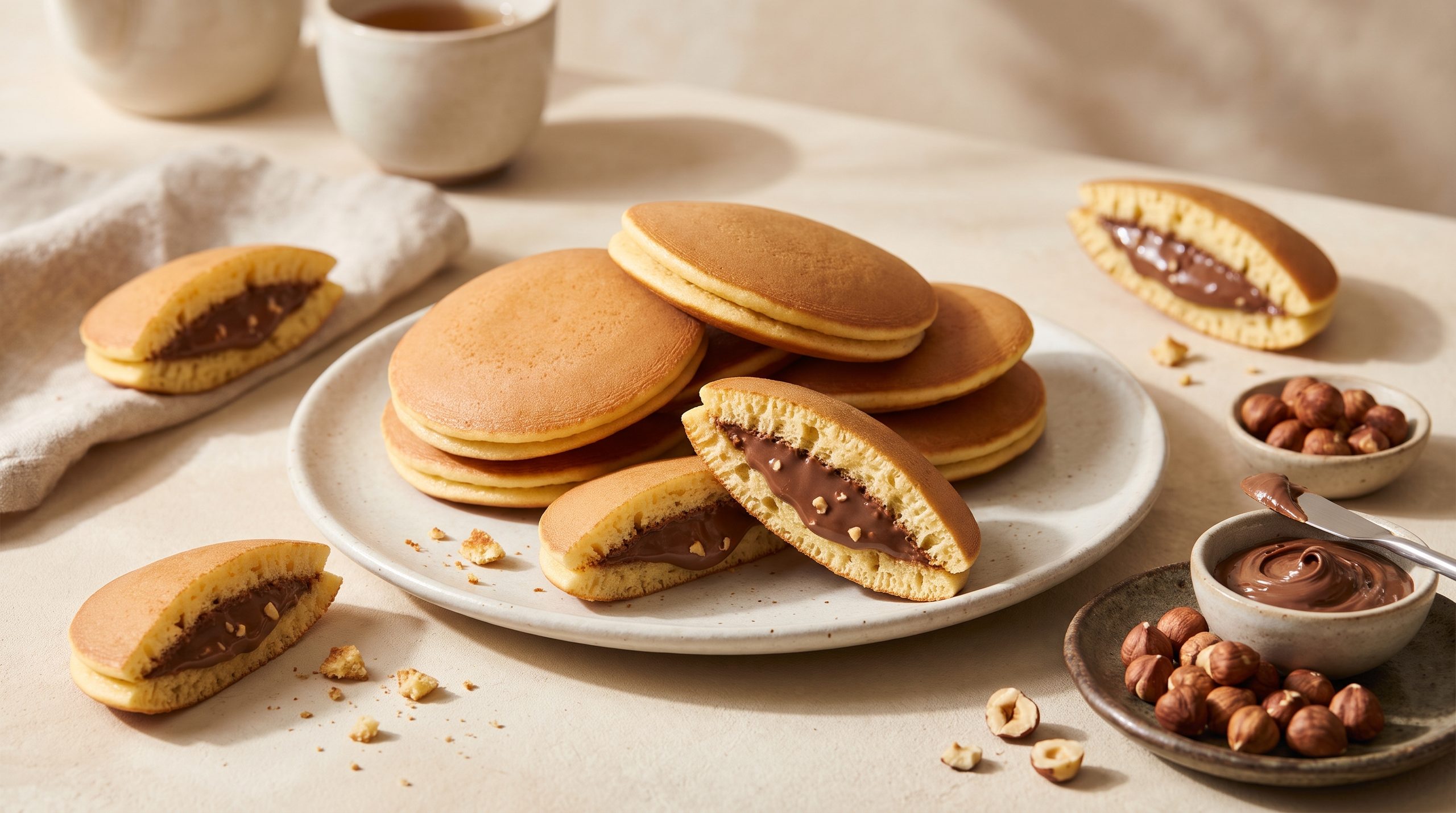
- chocolate and hazelnut creams
- custard and pastry cream
- jams and fruit fillings
- cheese and savory fillings
The important question is how the filling behaves. Thick pastes need a pump and nozzle that can handle viscosity without stringing. Creams that are too fluid spread and leak. Particles need an appropriate depositor. B&F pancake lines are compatible with creams, pastes, jams and similar fillings, and you can see the kind of precision involved in our article on sandwich waffle filling and quality control, where the same principles apply.
If you cook your own custard or cream, a vacuum cream cooker lets you cook at lower temperature, which helps protect color and flavor.
Stage 5: Sandwiching, sealing and printing
Once the fillings are in place, the second pancake closes the sandwich. A press unit can seal the edges for a sealed sandwich pancake, which is a more stable format for transport and shelf life. On B&F lines, the machine with a press unit can produce all three standard varieties.
A printing unit can add a logo or design directly onto the pancake surface, using quick-swap print heads. For brands, this is a cheap way to turn a generic pancake into something recognizable.
Stage 6: Cooling and packaging
The finished dorayaki needs to cool before packing, or condensation forms inside the pack. After cooling, individual flow packs or other formats protect the product. Because the pancake is soft, handling matters: transfers should be gentle and the infeed to the packer should not stack or squeeze the product.
Packaging also determines shelf life. Soft, filled pancakes need a barrier film and, for longer shelf life, sometimes modified atmosphere packaging. Water activity, filling choice and packaging all work together here, and our R&D laboratory can test them on your own recipe.
Capacity: what a dorayaki line can produce
B&F pancake lines produce 5,000 to 14,000 sandwiches per hour, and the capacity for single pancakes without sandwiching is double. That gives you a clear way to match a line to a business plan:
| Business type | What to look for |
|---|---|
| Startup or regional brand | A smaller configuration that can be extended later |
| Established snack brand | Mid to high output with printing and sealing options |
| Co-packer | Quick format and recipe changes, flexible filling |
| Export-focused bakery | CE-certified line, sealed formats, packaging with extended shelf life |
You can also start with the oven and add sandwiching later, which is useful when you want to begin with single pancakes and move into dorayaki as demand grows.
Quality control points on a dorayaki line
Dorayaki quality is easy to see and easy to lose. Check these points regularly:
- Pancake weight and diameter after baking.
- Color and surface on both sides.
- Filling weight per piece. Giveaway adds up quickly at high speeds.
- Alignment of the two halves.
- Seal integrity where a sealed format is used.
- Pack integrity and metal detection.
Vision-based inspection and weight checks can reject defective pieces automatically before they reach the packing area.
Common dorayaki problems and where to look
| Problem | Likely causes | What to check |
|---|---|---|
| Pancakes brown unevenly | Plate temperature differences, batter viscosity | Plate heating, deposit weight, batter holding time |
| Pancakes tear when flipped | Underbaked or too delicate | Baking time, griddle speed, recipe structure |
| Filling leaks at the edge | Filling too fluid, misaligned halves | Filling viscosity, deposit pattern, alignment and press |
| Pancakes dry out in the pack | Overbaking, moisture loss | Baking time, cooling before packing, barrier film |
| Condensation inside pack | Packing while still warm | Cooling time and conveyor length |
| Weight varies between pieces | Dosing variation, batter air content | Depositor settings, mixing time |
Most of these problems come from the same small set of parameters: batter, baking, cooling and filling. A pilot run before you buy helps you find the right balance for your own recipe.
Product ideas that sell
Once the line is running, small changes give you a wider range without new equipment. Producers commonly vary the batter with cocoa, matcha or fruit flavors, make mini versions for kids and portion control, print seasonal designs on the surface, or offer double-filled versions with two layers of filling. Because the same line makes plain pancakes, dorayaki and sealed sandwich pancakes, you can test new products on short runs and keep the ones that sell.
What to ask a manufacturer before you buy
- What is the real output for my recipe, not the nameplate output?
- Can the line make single pancakes, open sandwiches and sealed sandwiches?
- How easy is it to change fillings and clean the filling system?
- Can I add printing, sealing or additional filling later?
- Can I run my own batter and filling in a pilot trial?
- What is included in installation, commissioning and training?
Frequently asked questions
Build your dorayaki line
Tell us your product, filling and target output, and our team will configure a pancake line that fits. Request a quote for a dorayaki production line, or explore the pancake and sandwich pancake production lines.
Contact Us Today
Discuss your project with our engineering team and discover how our machines can optimize your production.